When you’re in town for a conference for just a week, you won’t have time to figure out the in’s and the out’s. When I’m leaving a conference, I often think “I’ll really nail this next time I’m here.” My goal with the below is to get your comfortable with a (literally!) foreign place so you can feel more at home and relaxed, and have more fun, see more things. Amsterdam has so much to offer, but if you’ve been in America most of your life, it’ll be hard to figure out the API, so to speak. Hopefully I can give you a head start.
Two pieces of context: I have three kids I don’t really know too many restaurants, bars, or party-fun things. And, this is written for Americans, North Americans (hi, Canadia!) that are more used to how things work over there. If it seems obvious, good job: you’re a regular cosmopolitan, guv!
I mean, obviously, you pay for everything in Euros. At the moment the Euros to the US dollar hovers between $1.07 to $1.09. If you’re really pricing things out, you also need to take into account tax, which is steep compared to US taxes. Apologies for being whatever, but, look: if you’re attending KubeCon, you’re probably just fine financially. And maybe you’re also expensing most everything to you company. Don’t stress about it.
The most annoying thing you’re going to find (again, for North Americans) is that many places do not accept credit cards. Credit cards are not as much of a thing in Europe as they are across the Atlantic. Instead, people use debit cards. (We could discuss how much more awesome European banking is than US banking sometime.) Cash isn’t actually used that much, and many places only take, as they say “PIN Cards.”
In the tourist areas and most big shops, sure, credit cards are taken. But you’ll be shocked to find, for example, that the big grocery store chains often don’t take credit cards. And the further out from the tourist part of Amsterdam you get (see below), the less frequently credit cards will work.
Oh, but here’s the good news: paying with your phone will work everywhere. It’s pretty amazing. Load up credit cards, debit cards, and Apple Cash on your phone and use it everywhere. You can also use tap to pay cards but, like, why? I know Apple Pay (or whatever Android thing) is now common in the US, but if you don’t pay for stuff with your phone a lot, take the chance here to nerd-out and pay for everything with your phone. FUN!
Now, credit cards will probably be good enough for if you’re at a conference. Most all restaurants will take them, most shops…but not so much grocery stores (I’m sore about that, obviously).
With credit cards, you want to make sure there’s no foreign transaction fee on your card. Or, at the very least, that it’s low. Most pay-for credit cards nowadays don’t have fees, I think.
Two more things: if asked if you want to pay in dollars or euros, always pick euros. Whatever exchange rates your credit card gives you (typically, the current exchange rate) is going to better than whatever whacky rate you’ll get otherwise.
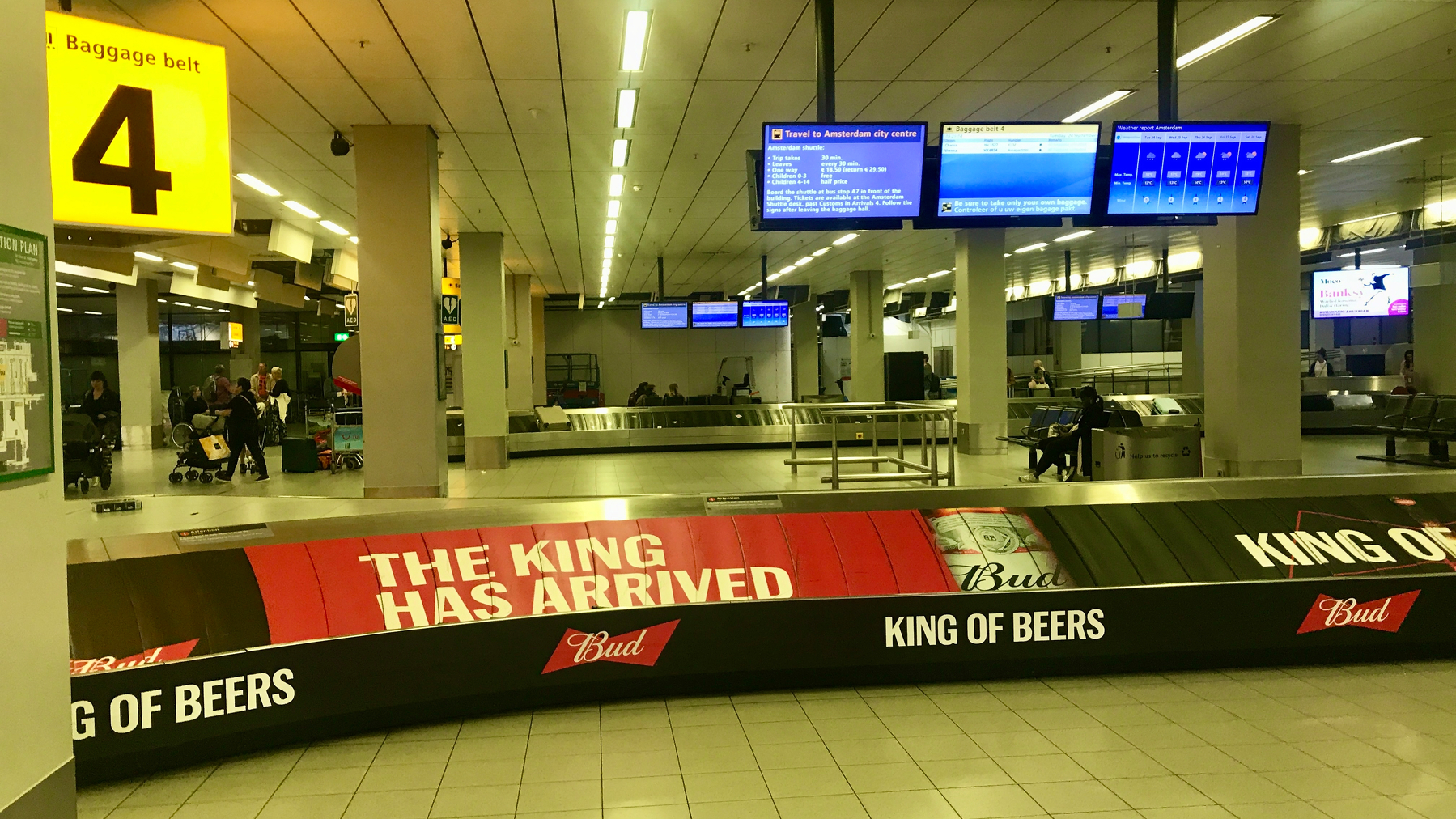
And, American Express isn’t widely taken, at all, despite the signs you’ll see in the airport. (Every time I see those signs, I think the same thing when Budweiser plastered ads in Schiphol and tried to enter this Heineken town: good fuckin’ luck!) Only the high-end stores, restaurants, and hotels will take American Express. Probably. So if you’re planning on using a corporate Amex, that’s not going to happen: save your receipts for those cash reimbursements. Every expense auditor in the world knows that American Express is crap in Europe, so don’t freak about it.
So, what do you do? You need a debit card. US debit cards sometimes work, and sometimes don’t. Plus, you’ll need to check if there’s foreign transaction fees on your debit card. It might work! Or not!
After some tests, I’ve found that of all things, Apple Cash works pretty well. This means you’ll need to link up your debit card to feed it cash ongoing.
I’d just bring all the debit cards you have and see what works. You can test it out in the airport to get started.
And, there’s always cash. Finding an ATM is harder than it should be now-a-days. There were a bunch of crooks who’d rob ATMs by blowing them up (I know!) several years back, and they also just started consolidating ATMs. Overall, the Dutch finance system doesn’t like cash.
As with any place, no merchant likes to take big bills (more than a €20)…like all those €50’s and €100’s you got from the ATM. When you try to use those big bills they’ll look at you like you’ve just eaten their children, but if you tell them you have nothing else, they usually (miraculously! who knew!) just pull up the cash drawer and make change. Also, most ATMs will let you select a mix of lower bills than just €50s and €100s if you look through the menus.
In general, I hardly ever spend cash. Like, seriously, maybe once or twice a month.
If you use cash a lot, you’re going to end up with a lot of coins. There is no €1 bill, so you’ll get €1 and €2 coins a lot. I’d keep a couple of 50 cent and €1 coins always in case you need to pay to pee, use a museum locker, or use a grocery cart (what is the deal with me and grocery stores?). But, to avoid a pocket full of coins at the end of your trip, try to spend the coins first.
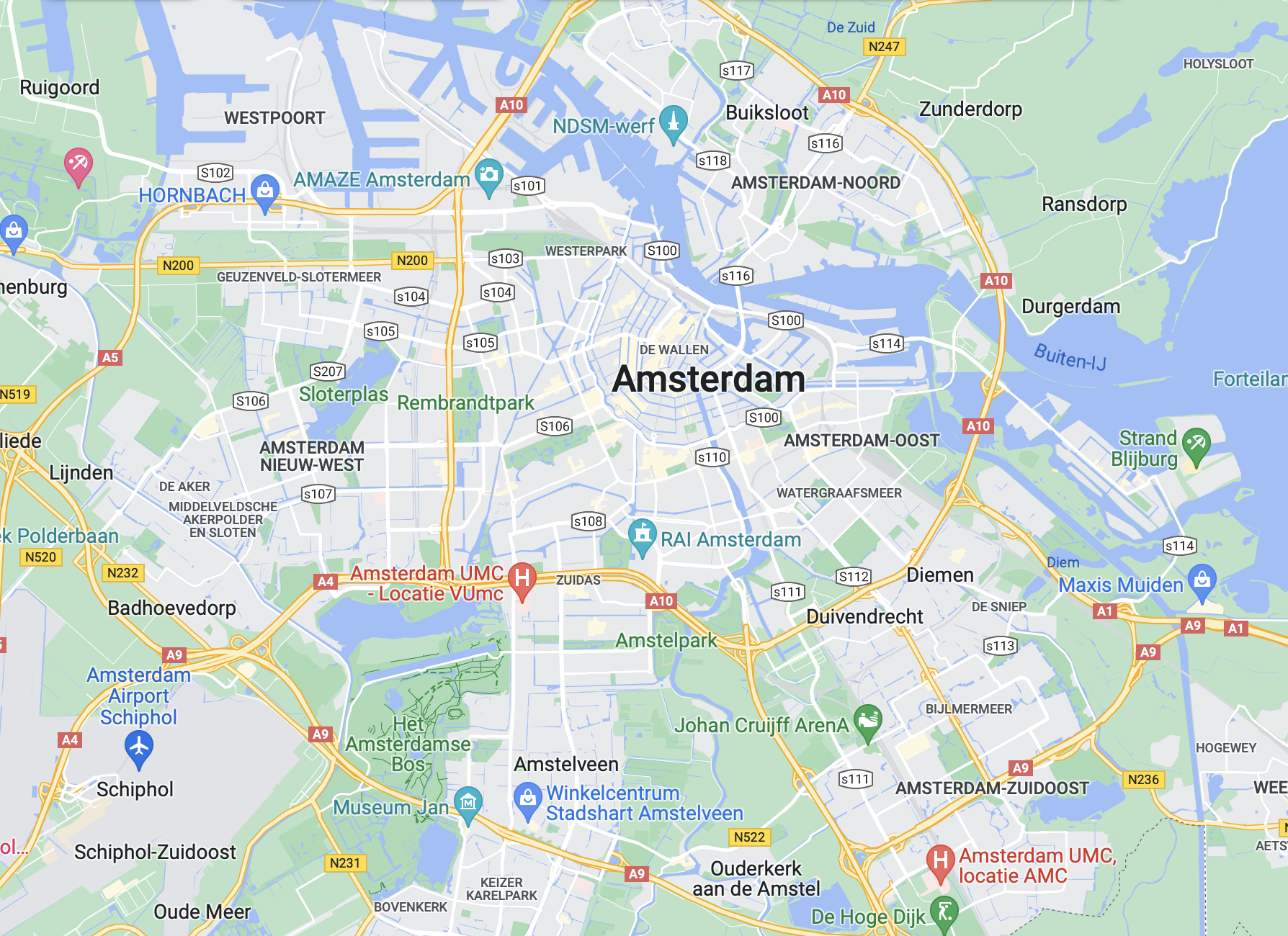
Amsterdam is actually a small place. The part you’ll end up spending your time in is tiny (that part inside the A10 highway loop). I mean, I’m from Texas where things are so spread apart that if you didn’t have a car you’d likely die of starvation.
In comparison, getting most anywhere you’ll want to go in Amsterdam will take, at most, 20 minutes by bike (see below). For example, from the RAI conference center (where KubeCon is) to central station, it’s 18 minutes by bike:
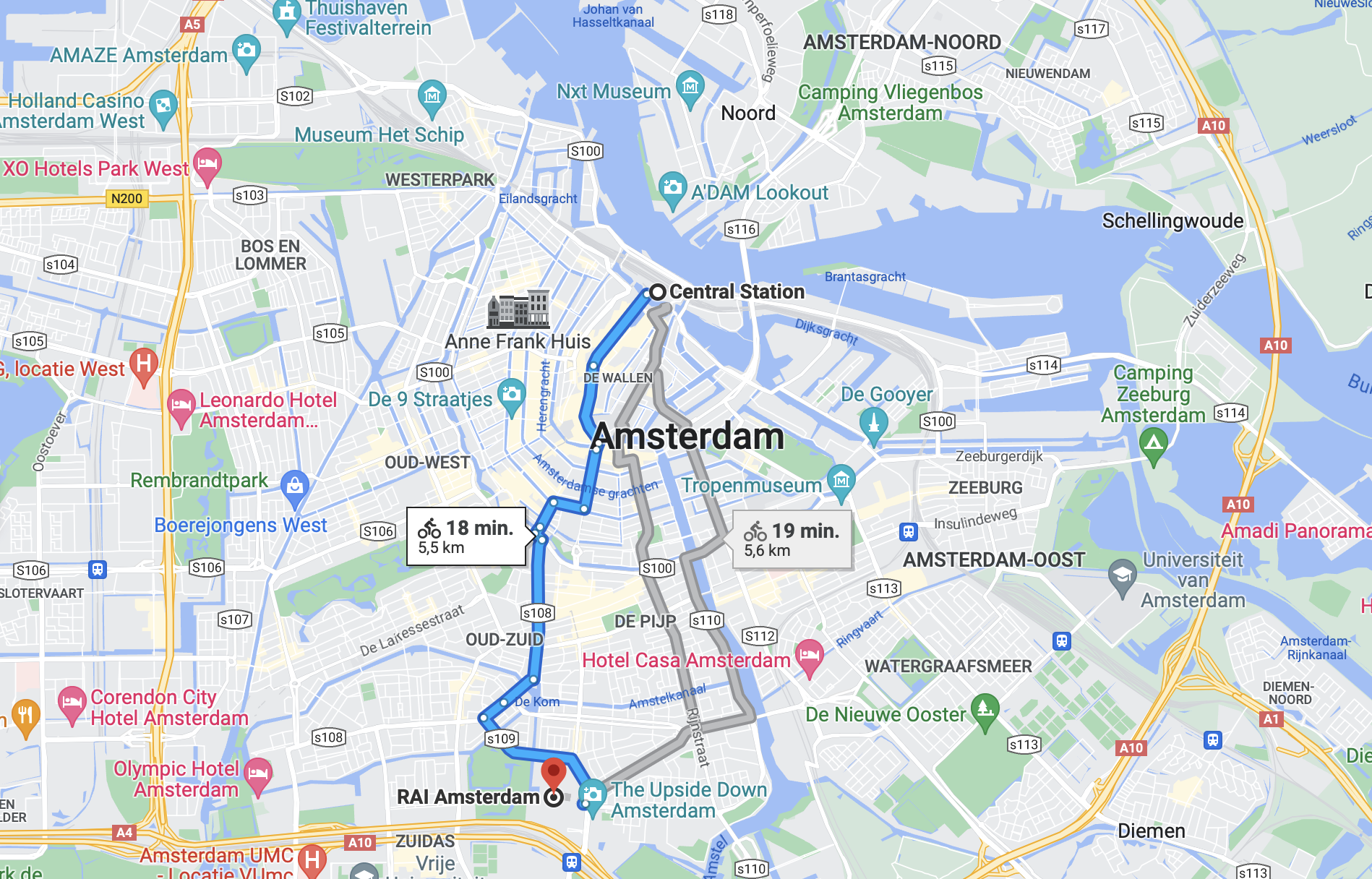
It’s best to think of Amsterdam as a bunch of rings because…it is! You can see it in the maps above. Those rings are canals. You might think you should go straight between two points, but you’ll usually end up traveling along the rings, following a canal until you find a bridge to cross, then following the next canal until you find a bridge to cross. And so forth.
You’ll want to use Google Maps for everything. It’s great. Unlike Apple Maps it has bike routes (more on that later). It’ll tell you exactly what public transit to use (more below), timing, etc. And it has walking instructions, and so forth. (I don’t know about the other mapping apps.)
To the north, you have the IJ river (pronounced, more or less, “eye”). You can take free ferries to get across the river and see the north side which is…not much for a tourist. This is one of the things I wish I’d figured out earlier: taking the ferry is fun and free, just hop on it for no reason, maybe get a burger at The Butcher, and go back. You can bring your bike.
The area around Centraal Station is the most historic. The idea of a “stock market” (and thus, pretty much, “capitalism”…yay) was invented on a bridge there, and you’ll see rows and rows of buildings that look like maximum Amsterdam.
This part is also maximum tourist, both in people and types of places. As you get further and further from Centraal Station, the tourist level decreases pretty quickly. Once you get to the Rijksmuseum and Vondelpark, the tourist ratio is less…icky. I mean, you’re a tourist so this is fine. The point is more to make sure you see all the parts of Amsterdam, not just touristy parts.
The city is an incredibly beautiful, friendly, and nice place. The area around the museums and Vondelpark is high class, De Pijp is where things get normal, and the area around the conference center is as normal as Amsterdam gets.
Amsterdam has an unexpected amount of parks and green spaces. You’ll see little pocket playground and parks throughout the city. You could spend days exploring all the parts of the cities main park, Vondelpark.
Remember: Amsterdam is small. Don’t take cars. OK, if you’re lost and you just want to get back to your hotel, sure, call an Uber. But, in general you should either be walking, taking public transit, or, best, biking.
Let’s talk about bikes. I tell everyone who comes here that the first thing they should do is rent a bike. Most people don’t follow that advice, and then we end up having to putter around with walking and busses.
You need to rent a bike.
Maybe your hotel has one. The problem with me giving this advice is that I don’t rent bikes - I have two already! So I don’t know where you should go. When friends are in town, we’ve gone to the closest Het Zwarte Fietsenplan store. I don’t know what to tell you: rent a bike, you’ll be glad you did. You’ll be able to see so much more of the city, get to places quickly, and so forth. It’s like fast software release cycles: the faster you can deploy software, the more you can do.
You should rent a bike on day one (of being fully awake) so that you can spend a day practicing. I’m used to it now, but at first biking around Amsterdam was INSANE. But it only took a little bit of studied experience to get used to it.
Here is what you should know for biking around Amsterdam:
Amsterdam (and much of the Netherlands) is built around the bike as the primary means of transit. There are fully dedicated bike lanes (like, sectioned off with curbs and stuff) on all major streets, and if there’s not, you’ll see painted on bike lanes. If you don’t see a bike lane, you bike on (in?) the street.
Here is the thing to keep in mind: most people give bikes the right of way even when the bike doesn’t have the right of way. Of course, this doesn’t man you should drive straight into car traffic or foot-traffic, like, at all. Don’t be stupid.
Bike riding is a lot like driving a car. The bike lane - no matter how narrow - is divided into two lanes, the fast/passing lane on the left, the slow/“driving” lane on the right. Stay in the right lane.
The bike lanes usually have traffic/bike signals. You’ll see them, little lights that are green bikes for go, red bikes for stop. Obey those signals, not the car signals.
Yielding is a fine art. If you see “shark teeth” - think white yield signs (triangles) painted on the ground, whoever the triangle is pointing towards is supposed to yield. This is mostly for cars. It gets complicated with bikes. I don’t see bikes consistently obey these shark teeth except when there’s heavy car traffic. Bikes are also supposed to yield at cross walks…but they rarely do. Here’s what you should do: if you’re confused, pull off onto the side walk to stop and figure it out. If you see a car coming and it’s not slowing down, you should probably slow down and see what they’re doing. Whatever you do, don’t just stop in the middle of a herd of bikes on the bike lane. Watch what all the other bikers do for a few hours and you’ll get it.
The bell. People use their bell primarily to tell you that they’re passing on the left. This is a favor to you, not an insult. You’ll be biking along on the right (yeah? You read the above, stay on the right side of the lane, right?) and you’ll hear this cute little bell tingle. That means someone is about to pass you. If you’re stopped at an intersection, you might hear one to tell you the light has turned. If you’re biking in the left lane, you’ll probably hear someone who’d like you to get out of the way (you’re probably not going to be biking fast enough for the locals - again, stay in the right lane). This constant ding-a-linging will be stressful at first, but it’s totally normal and fine. People aren’t pissed at you, they’re just being normal, polite even. You could try dinging yourself, but, I don’t know, I wouldn’t worry about it. It takes awhile to figure out when you’ve crossed the line from polite-dinging to asshole-dinging.
Lock up your bike, especially a rental. It will be obvious where you lock up bikes - there will be a lot of them. There’s usually bike racks, and you should chain your bike to them (you know, through the front wheel and the frame). There’s (to Americans) a weird lock on most bikes, a ring lock. This is a second lock that is attached under the seat of your bike and goes through the back wheel. Use this lock too. Whoever rents you the bike will show you all this. Always do both locks. Also, combination locks are virtually non-existent in the Netherlands (beats me, I don’t know why - I asked around when I first moved here and no one had a good answer), it’ll be keys. So, don’t lose your keys.
Turn lights (white on front, red in back) on at night.
In the denser, more tourist parts, don’t bike around on the side streets if they’re full of people. You’ll see some locals ding-a-linging their way through throngs of tourists, but, you know: don’t do that. Just hop off your bike and wheel it along.
I mean, it’s a bike. You’ll figure it out. The main thing is just to watch other people (the locals) bike around for awhile and do what they do. Successful biking is like successful driving: go with the flow, follow the conventions, and defer to not killing yourself and others if you get confused. You’ll be able to spot the rental bikes (the tourists - you!) and the local’s bikes. If you compare and contrast the two riding styles, you’ll be able to derive most of the advice above. If you’re really into it, here’s a Canadian’s ode to the Netherlands biking system.
This is my wife, Kim’s summary of what you need to know about walking in Amsterdam: “STAY OUT OF THE BIKE LANE.”
For you, in these part of town, you’ll be walking a lot. Per above, get Google Maps and use it a lot. It’s easy to get turned around, trapped on a canal without a bridge, and otherwise end up in weird spaces. The maps will help you.
That said, there’s a lot of pleasure to be had in “getting lost” if you like that (see below).
I’m going to assume you know how to walk, so I won’t cover that. Here’s some HOWTO, though:
Stay on the sidewalk. Your number one goal walking is to stay out of the way of bikes. You’ll be confused about what bike lanes look like versus sidewalks for a little while. Trust me, you’ll walk in the bike lanes a lot for the first few days; you’ll hear a ding-a-ling and what sounds like a spinning wheel of knives approaching you from behind, and almost shit your pants as you hop back onto the sidewalk. When you’re starting, as you’re walking around, always be asking “where is the bike lane?” and stay out of the bike lane. It should be pretty obvious. When there’s not a bike lane, stay on the sidewalk as much as possible, or at least close to it. Bikes don’t actually go on the sidewalk much and, in fact, I’ve seen locals yell at those bikers.
Cars obey crosswalks. This is fucking insane for Americans. In the US crosswalks might as well not exist. Cars will - and, listen, I know you’re not going to believe this, but just trust with me, it’s true - stop at cross walks for people. Sure, you need to eyeball the car and make sure they’re slowing down, but chances are they’ll stop. And, in fact, if you hesitate and they have to wave you on, they’ll get kind of pissed.
Bikes don’t obey crosswalks. Even if one biker stops, be very cautious because there’s probably another bike sailing down the lane who won’t stop.
Are you catching onto a theme here? Bikes. If you’re walking, stay out of the bike lanes, look out for bikes, and defer to bikes.
To train yourself, spend five or ten minutes in the tunnel under Rijksmuseum and the intersection right outside the tunnel. You can go up to the American Hotdog stand right by it (free condiments!), grab a hotdog, and watch how the pedestrians and bikers flow together. You’ll see tourists again and again get into the bike lane, bikers ding-a-ling at them, but you’ll also see proper behavior.
Amsterdam is notoriously unfriendly if you need to do something other than walk, if you have a wheel chair, for example. There’s curbs, the sidewalks are small, the bridges steep, very few ramps anywhere, etc. And once you get inside most places, there will be narrow, steep stairs and no elevators. Museums and big hotels, larger stores, and some nice restaurants (and most chains like McDonald’s?) will have elevators…but don’t count on it.
The public transit in Amsterdam (and all of the Netherlands) is great. There are four types: train, tram, metro (subway), and bus. The buses and trams run on the street with stops, the metro and trains run in stations.
To pay you tap in and out (like any other transit, really). You can pay for each trip with the driver (or ticket taker in the middle of longer trams), at a machine in a station (and some stops), with a tourist card, or, best, with your phone. Credit cards (on your phone) work here, unlike elsewhere. I recommend your phone.
The public transit runs on time and is orderly. Sure, if there’s construction or something weird, it’ll be delayed, but otherwise it’s dependable.
You’ll probably take busses and trams the most. They are both good. Trams are fun! You’ll see little signs telling you where you can enter and leave. In buses, you enter in the front, in trams you enter in the front and the middle sometimes.
Trains and the metro are in their own station. If you switch between a train and metro inside the station, you’ll need to tap out of one and tap into the other. Train tap-in/out stands are yellow, metros or red. Also, trains and metros show up on platforms. Google Maps will list this and, of course, there’s big screens in the stations.
This video looks like a pretty good overview - here’s the part about checking in and out so you can see what that’s like. The major difference three years later is that you can pay with your phone.
If you don’t want to pay with your phone, I’d get one of the three or five day tourists passes right at the airport when you depart. You can get them at machines or a desk. Go to the machine, it’ll be faster.
Schiphol is a great airport. I’ve been to many airports and travel all the time. It’s a large airport, but well organized and centralized (there’s really only one terminal, unlike, say DFW, LAX, Heathrow, etc.). Most everything is in the center of the airport with long concourses branching off. It’s a European airport, so you have high end shops, pretty good restaurants, etc.
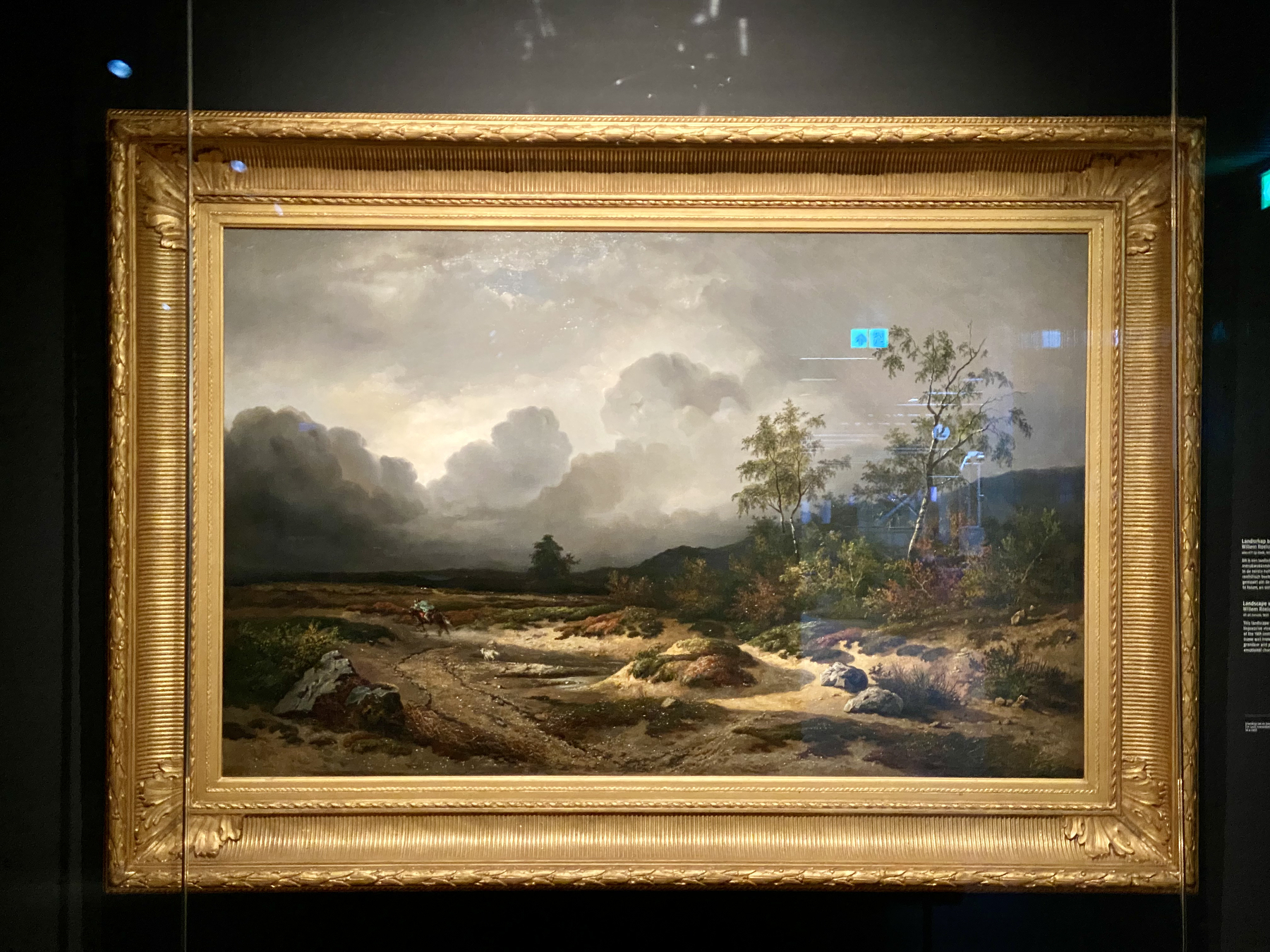
The main, “secret” attraction is a tiny museum run by the Rijksmuseum. It has rotating pictures from the museum that are great to go see. This is in the international terminal, where you’ll be, so go check it out.
When you arrive, you’ll just go into the normal terminal. This is unlike entering the US (or the UK) where you always have to go through numerous Cabin the Woods tunnels to go talk to the border guards.
Instead, the Netherlands has the border guards in one, little choke point as you exit the terminal. Follow the signs to it and plan on it taking a long time if you don’t have a Europe passport. It’ll just suck. The boarder guards will ask you why you’re there (a conference), where you’re staying (the Amsterdam Marriott, or whatever), and how long you’re staying (however long). They’ll usually stamp your passport, smile, and tell you to have a good day. If you’re used to US boarder guards, you’ll be shocked at how nice the Dutch are. It’s like they actually want you to be there!
Baggage claim is big and sprawling and can take a long ass time. There’s staffing shortages in Schiphol so everything takes awhile now-a-days. You’ll (eventually) get your baggage (or not have any) and find the exits. There’ll usually be a customs guard or two standing there, but they rarely do anything but smile at you as you walk past.
Then you’re in Schiphol. This part of Schiphol is smaller than what you’d expect for a big city airport, but packed with stuff. What you’ll want to do is go to the center. Here’s my annotated map:
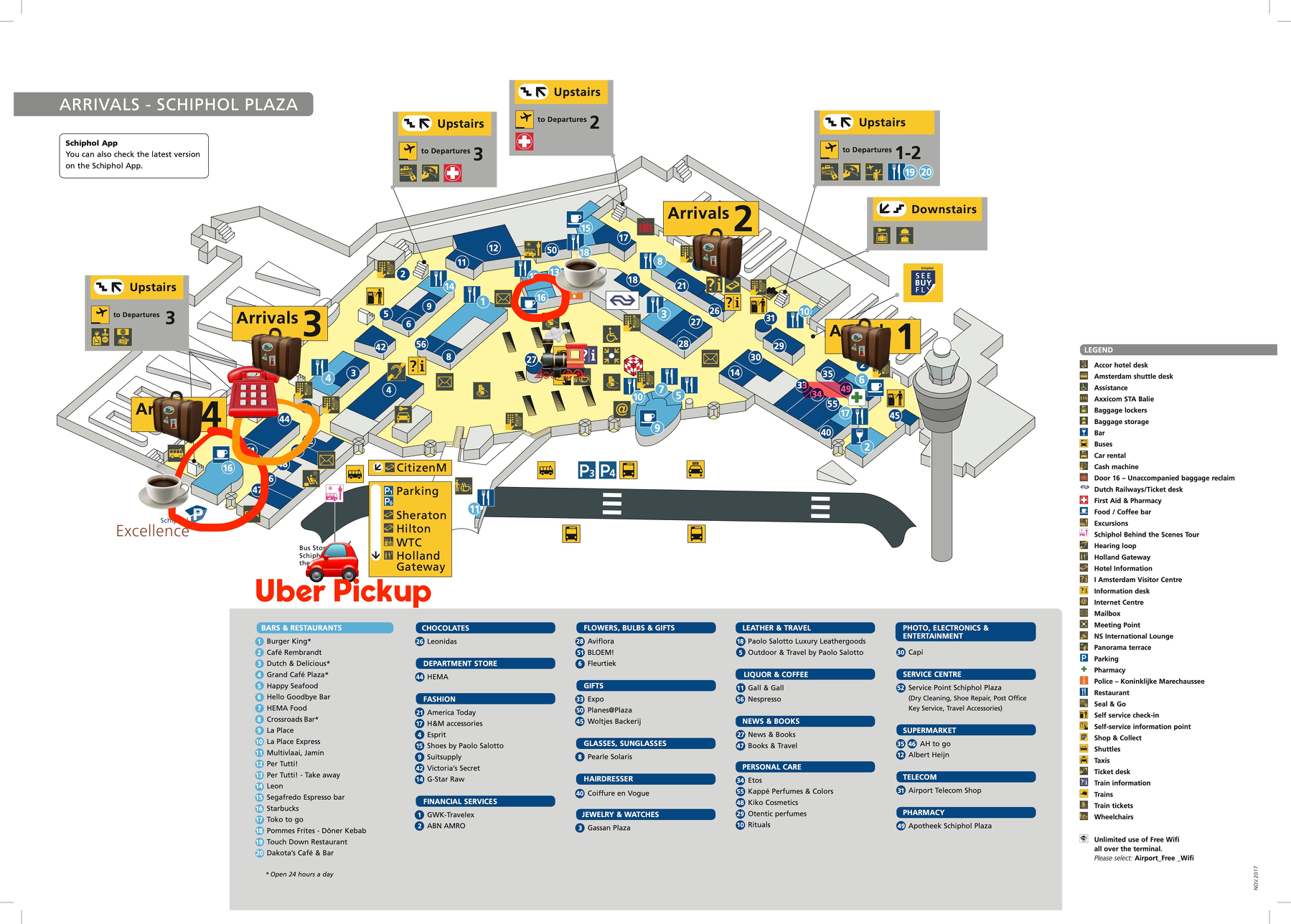
The little luggages (arrivals) are where you’ll probably come out. I bet you’ll want some coffee! Well, fellow Americans, you’re in luck, there are two Starbucks, circled in red with a little coffee cup next to them.
The next thing I recommend you do is get a SIM card. If you already have your phone’s data sorted out with Google Fi or some affordable international add on (AT&T is still, like, $10 a day last I heard), go get a SIM card and stick it in your phone. There are vending machines now-a-days that will have these (and other things), I think around #56 on the map? But, you can also go to the Target of the Netherlands, Hema, circled in orange with a red phone next to it. Right next to the checkout counter, they’ll have SIM cards. Hema will take credit cards!
Also, people in Europe use WhatsApp, like, a lot. So, if you want to txt with people here, you should get that. Of course, if you have data and you’re talking with people in Apple Messages that’ll work fine. But at a conference, there’ll be a mix of Apple and Android people (esp. at a nerd conference with open source favor like KubeCon), and they’ll want to create group chats in WhatsApp. So you better get WhatsApp. Did I mention that?
When you’re going home, I’d leave for the airport three or four hours before your flight. The security lines at Schiphol can be nuts nowadays so you should be careful. The airport is pretty nice, so having to spend a hour or two extra there is OK.
If you’ve never been to Amsterdam, you should just take an Uber to your hotel. You’ve been on a long flight, don’t stress about figuring things out.
Finding the Uber pick-up spot is difficult at first. Their location description in the app is crap last I check. Here’s where it is, more or less where the red/pink circle is:
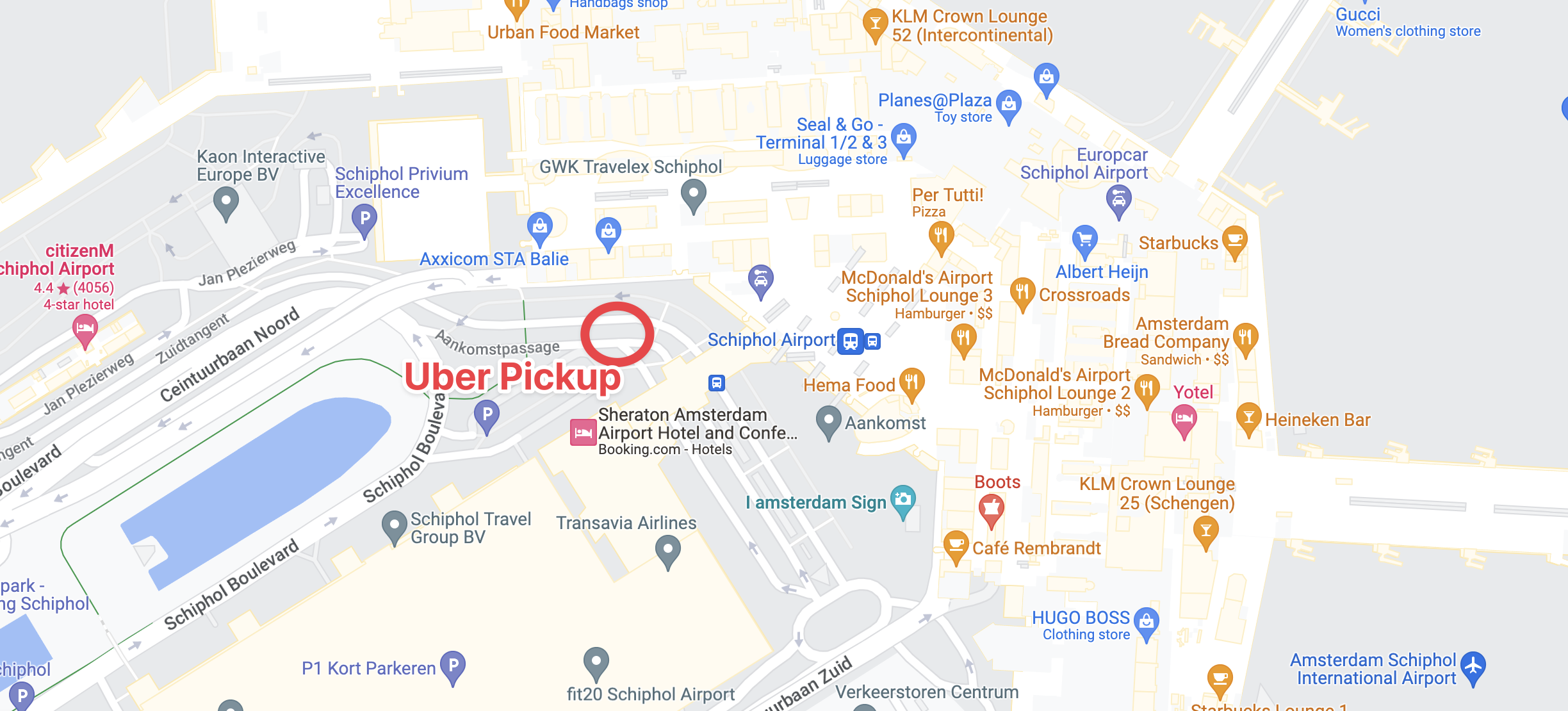
You’ll see a bunch of people waiting. If you’re “lucky” you’ll see the illegal taxi drivers with little signs saying “Taxi” and stuff. They’ll probably ask you where you’re going, blah blah. Just avoid them.
If you want to figure things out, you can take the train. There’s many, many trains that will go to Centraal station and you’ll also be able to get the RAI station if you’re staying near there or just want to get to the conference center. The train is the best option if you don’t mind sorting it out. Nowadays, I take the train to and fro the airport.
The train might is also a good way to get to the airport. You’ll avoid traffic.
This is a good overview of getting the train from Schiphol - again, you can now use your phone to pay so you don’t even need to buy a ticket…unless you want to.
Before you leave the airport, treat yourself to a free bathroom fully stocked with paper towels, soap, and lots of urinals and roomy stalls. Aside from the conference center, this will be the last time you encounter that luxury.
That’s right: it’s hard to find a place to pee in Amsterdam, harder to poop. Back in the states, you can walk into any store, grocery store, fast food place, pretty much anywhere that has an operating door and indoor plumbing and just go use the restroom. This is not how Amsterdam is.
First, “bathrooms” and “restrooms” are called “the toilet.” As in, “where is the toilet?” Second, only restaurants have public use toilets and they’re sometimes locked with a code and, you know, the staff is all like “you need to pay.” (In reality, I find that if you just walk in there like you know what you’re doing, you can pee and sometimes pay by taking a scornful look as you leave.)
You’ll find toilets at the conference center, and if you’re eating or drinking somewhere, they’ll have a toilet you can use. It’s a good excuse to get a coffee.
Now, if you pee standing, in the center you’ll find several places to pee. These are tall, dark green mesh cylinders that have a urinal in them. There are a couple fully functional public restroom boxes that self-clean after each use.
But there’s no toilets otherwise in stores like you’d expect in America. IT IS FUCKING CRAZY.
Here’s a map of public toilets.
As a small bladder person, my advice is that if there’s a toilet you can use, use it before you leave even if you don’t need to pee.
Amsterdam is a normal, global city. They have everything you’d want to eat. OK, as an American, not everything: there is no American Chinese food (duh!), very little Tex-Mex (though, some surprises), and a lot less Thai places that you might be used to.
But they have all the rest. The ramen is pretty good and easy to find.
And, look, let me just level with you, and I apologize to the kind Netherlands people who let me live here…most Dutch food is not good. I mean. It’s “not good” in the same way that Kraft Mac and Cheese is “not good.” Us Americans think of Kraft Mac and Cheese as what they serve you in the afterlife if you’ve been good. It is the food that runs through our American veins and might as well be on the American flag. But the rest of the world when confronted with Kraft Mac and Cheese are like “ah…this…[throws up a little in their mouth]…pardon me…this explains a lot about Americas.” (Let me level with you, fellow Americans: Kraft Mac and Cheese is shit food…cough, erm…we bring home 20 boxes every time we come back from the States.)
The Dutch foods you want to eat are:
Bread and sandwiches. The Dutch bread is phenomenal. It is amazing, always fresh and good. They make a pretty good sandwich out of it too. All the little breads are good too. You should try pretty much any bread-based product.
Fries. The Dutch fries are excellent and fresh. They’re slightly different than Belgian fries, and definitely better than “French fries” and steak or home-fries. If I were you, I would eat a lot of Dutch fries. You’ll have to pay extra (30 or 50 cents) for each condiment and you won’t get free condiment refills. There’s a lot more than ketchup and even mayo. Do whatever you like. The ketchup isn’t Heinz so it’ll taste kind of weird. The mayo is good.
Kapsalon Fries. This is a tray of fries with soupy stuff on-top of it. Think chili-cheese fries, except with all sorts of different toppings. We go to a place that’s a bit far from where you’ll be, Freddy Fryday, but you can browse their menu to get a sense of Kapsalons.
You can experiment with other Dutch food, and I’ve probably forgotten some. They love to deep fry things, which can be fun. If you like midwest hot-dishes, you might like Dutch food.
The two unique things you should seek out are (a) a rice table, and, (b) Surinamese food.
A rice table is a banquet of little dishes of Indonesian food. You pay a set price and they bring out, like, 15 or so little dishes and big basket of rice. It has a long history from colonial Dutch days and it’s good. We go to this place, Kartika - they take reservations now, which I’d recommend. It’s walking distance from most places.
I don’t actually eat that much Surinamese food, which is a bummer. Surinamese food is a mixture of Caribbean, Indian, Chinese, African, Indonesian, and Dutch food. It’s spicy and full of noodle, chicken, beef, and all sorts of fun stuff.
Also, for fun, you should have two more things: a Febo burger and a Hema hotdog.
And, yes, Herring. It’s just like you’d think it would be, have some.

Like I said, I’m not fun. I don’t go get weed (ever) or go to bars (much).
In the Netherlands, a place where you buy pot is called a “coffeeshop.” An actual place where you buy coffee is called a “cafe.” “Coffeeshop” only ever means one thing.
They work just like any other bar. You walk in, ask about all the options, and then buy it…like…with your credit card. It’s a little weird. I don’t think they sell alcohol there, which is weird. You can hang out there or go elsewhere. You can smoke there. I don’t know what the laws are and, again, I don’t smoke weed, but I see people walking down the street, hanging out in parks, whatever. Here’s some more advice on rules.
Just, like, be cool. Try not to smoke around families and locals. The townies aren’t really too cool with weed. It feels like every year they try to ban it, but it’s still here.
Now, I do know something about drinking.
They serve beers in two sizes, small and large. You probably want a large.
Heineken is a fine beer, the Bud Lite/Mexican beer of the Netherlands (no limes - that’s a good idea, actually). This is where Heineken is from, so you should have some, if not a lot.
I’d next drink Belgian beers, and then German beers if you have the time. Hear me out on this next one: I’d go to the grocery store (an Albert Heijn or a Jumbo) and get some bottles of Belgian beer and go have a little picnic in the park or drink on your balcony (if you have one).
You’re right next to Belgium, so there’s all sorts of Belgian beers. I’d get the genuine Trappist beers, start with the Rochefort and the one with that cartoon smiling monk. The second might not be genuine, but I think it uses the same recipe. Have some of those, and then go have a nap.
There’s a lot of microbreweries in the Netherlands now. If it’s a sunny day (or, you know, not), you should go to Brouwerij 't IJ and sample what they have. They have an actual beer garden (not common in Amsterdam) and good pub food. Their beers are good too. And it has a windmill.
I haven’t been in a long time, but I remember that Cafe Gollem Amstelstraat was good, had hundreds of beer, and it’s central.
For German beers, Café Brecht is great and right next to the Rijksmuseum. You should go there for sure because it’s a nice version of the traditional Dutch “brown bar” (a neighborhood bar) and overall comfy. They have warm soup!
Drinking in public is confusing to figure out. It’s obviously illegal in many places (there’s signs!), but you see people drinking plenty while picninic’ing in the park. You don’t see people strolling down the street with a Heineken tallboy. Here’s what someone on the Internet says. Again, I don’t know the rules.
Save your wine drinking for France, Spain, and Italy. Well, if you go the grocery stores or wine shops you can get French wine super cheap, relative to the US. My wife and I joke that it’s hard to spend more than €20 on a bottle.
I don’t know anything about the Red Light District. You should go walk around there to just, like, see what the deal with all that is, but as far as anything but pushing through the crowds, I couldn’t say. Don’t take pictures. Someone will come yell at you.
If you want to go to the Anne Frank house, it might already be too late if you haven’t booked tickets. Go book tickets now.
The Van Gogh museum is a little better, but you should go book tickets now.
The Rijksmuseum is great and you don’t need to book tickets ahead of time, maybe the day before. BUT, there’s a special exhibit of all the Vermeers (except the girl with the pearl ear ring which is back in…The Hague?…now). Check on that special exhibit for scheduling.
You should take a canal cruise, the smaller the boat the better. Ask to take to take UNESCO route. We’ve hired Those Damn Boat Guys in the past and they’re more expensive than, like, people who hand you flyers in front of the Rijks, but much better. You can bring all your own food and drink and make a nice three hours out of it for a group of four, 8, or 10, I think.
You’ll be here during tulip season which means you’ll see pots of tulips all over town.
The Dutch are very nice, friendly, and warm people. First, English is, I don’t know, a native language, so you’ll get by just fine. Second, for Americans especially, the Dutch can seem direct - maybe even “rude” if you’re a bit American-provincial. This probably won’t come up for the short amount of time you’re here, and in the parts of town you’re in, but Dutch people will tell “how it is,” but with a smile and good humor. But, again, that probably won’t come up too much. My point is: if you feel insulted or suddenly off base in a conversation, that’s probably not what’s happening: it’s just a different way of talking. Everything is fine and friendly!
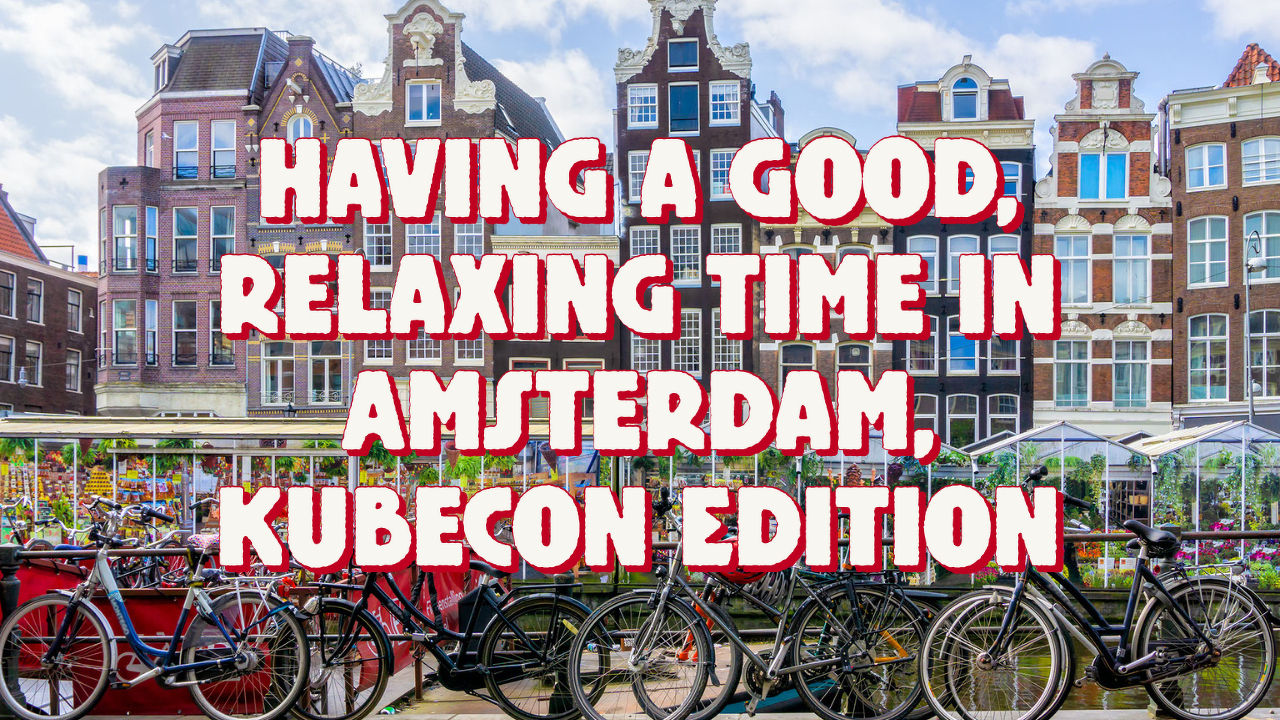
I’ve mentioned before that I really enjoy the museums in Amsterdam and the paintings from around Dutch Golden Age in particular.
You can buy a tourist museum pass that will get you into most places, or just buy tickets directly.
Amsterdam is full of museums and you can spend days in them. Here’s what I like:
This is the big museum going back to medieval times (all the Mary’s and Jesus’ stuff) to the present. You should go here to see the Rembrandts, Vermeer’s, Van Gogh’s, and many more on display.
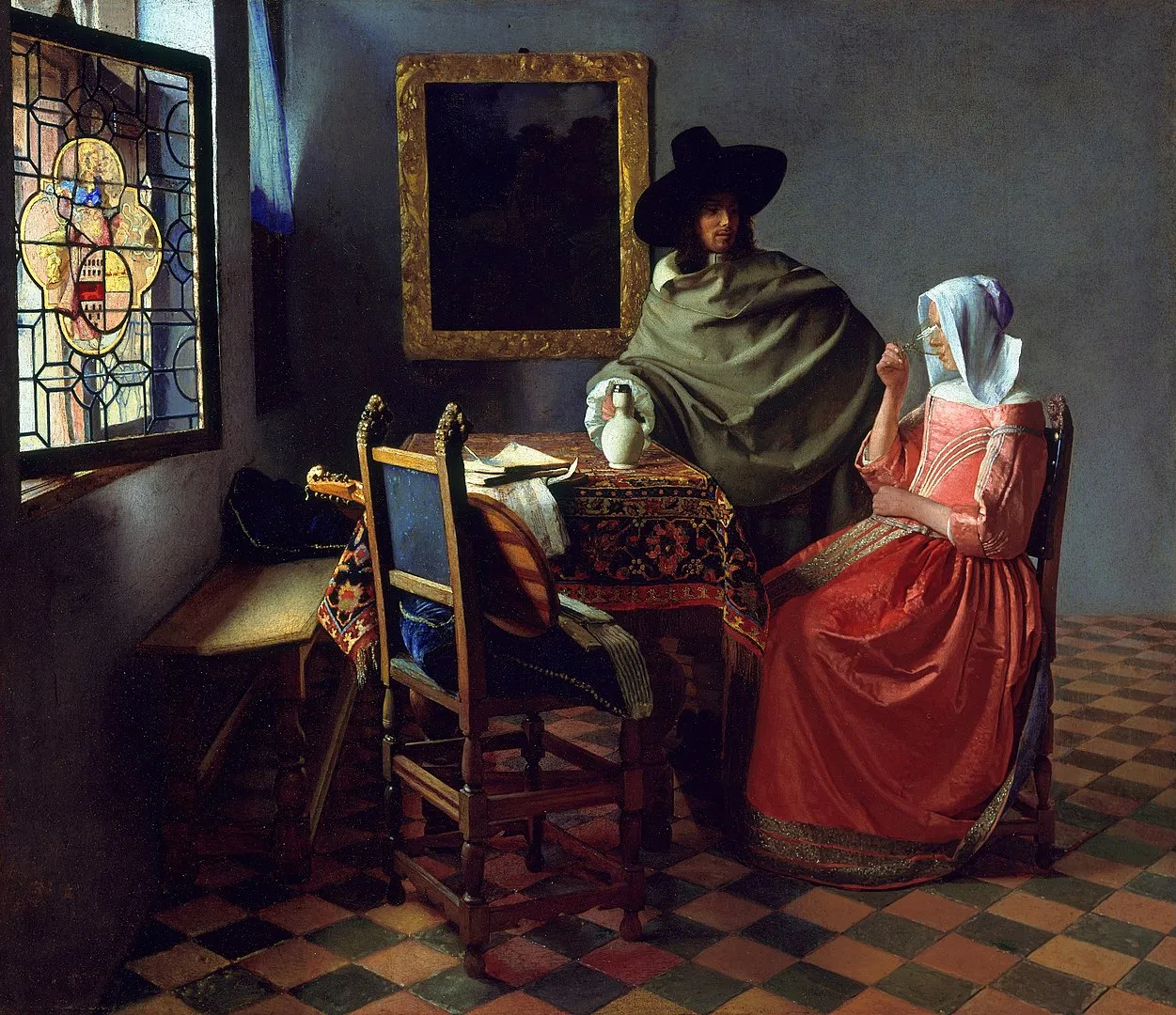
Right now, there’s a special exhibit of many, many Vermeer paintings in one place (minus The Girl with Pearl Earring) which is, sadly, fully sold out. No Vermeer for you! I’ve been - hahahahah…er…sorry…gloating.
But! You can go to the rest of the Rijks at anytime, just get tickets online.
If you were like me, you’d spend an afternoon here looking at everything. I’ve been known to take in a notebook and iPad and work in the museum. I wrote some of my recent books in there.
Here’s my highlights:
Obviously, go to the “hall of honor” and see all the great paintings there. Take your picture in front of that pissed off swan, find all the raucous families. If you don’t have much time, just go right up there and spend the time you have with those paintings.
Make sure to go to the Asian collection, it’s a bit hidden and off the main path, and there’s a downstairs section that’s easy to miss. The collection of China (plates, vases, etc.) is really something, as are the chill Buddhas and Indian gods.
I very much like woodcuts, etchings, and illustrations and you can find many of those in little alcoves.
Don’t skip the Greek statues in the lobby: who doesn’t like a _Laocoön and His Sons_? During the pandemic when everything, including the Rijks, was shut down I’d bike through the tunnel and look into the lobby to see that statue to get a little feeling of comforting-normal.
Go to the model ship section and find the holograph-man pooping.
The cafe is good, but pricey and usually has a short wait. However, it’s a good place to get some wine and/or beer, a slice of Dutch apple pie and chill out for a bit.
I’ve never done this (but want to!), but a pro tip if you don’t mind looking like a dork is to bring binoculars to get a really close view of the paintings. I guess you could bring a telescope if you really wanted to silently scream out “LOOK AT ME!” as you unhook it from of your utility-kilt EDC-clip
You should go to this one too, and you’ll need to book tickets ahead of time. If you’re reading this now, do it now. Good luck!
This place is exactly what it says it is. It doesn’t have Starry Nights (that’s in Paris), but you’ll be fine.
More than most paintings, see a Van Gogh in person is a lot different than seeing a picture of it. There’s much texturing and layering. I heard recently that it’s fun to look at paintings and see how the layers of paint create shadows on the canvas. You ask yourself: was that intentional? Are the shadows part of the painting? MIND BLOWING, right?
Now, here’s something you should not feel bad about doing if you want to: it’s OK to just quickly walk by the repetitive paintings. I mean, especially the self-portraits. At some point, you’ll be like, “I get it. You’re an amazing painter and here’s you again. Look at you! And again. Aaaaaannnd, again.”
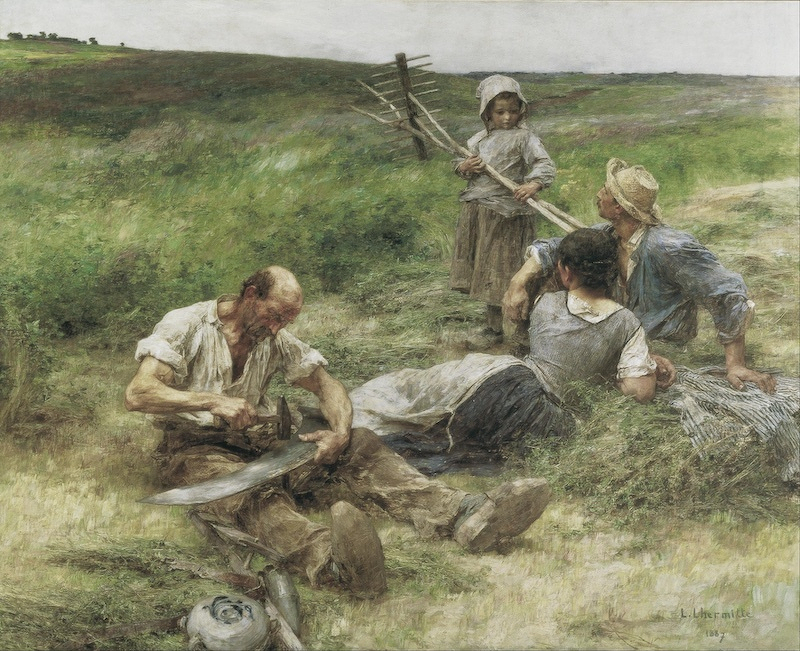
Two paintings you should find: The Potato Eaters and Haymaking (above). The second is not a Van Gogh, but it’s very calming to look at. And, yeah, if you want some Van Gogh hay pictures, you’ll get your fill.
These are the modern and contemporary art museums.
If you’re into design, the Stedelijk will be especially nice because there’s a lot of Bauhaus furniture and art in there: plenty of everyday objects designed well too. There’s a rotating exhibit (I don’t know what’s there now), paintings and sculptures, and some usually some fun posters, books, and other “paper” stuff.
The Moco is small and has a lot of Banksys in it and many more.
There are many more museums. There’s the maritime museum which can be fun, especially if you’re into history. You can also see the Anne Frank house. That’s another one that you need to book out early. It might even be too late at this point (the week before KubeCon).
And there’s all sorts of little, commercial museums like the torture and sex museums. I think I went to those when I was backpacking in the 90s. I went to the Heineken tour back then too, which was fun and you get beer at the end.
Here’s things that aren’t museums that are fun to do:
A’dam Lookout - here’s your chance to take the ferry across the IJ. You go to the top of a tall building there and get the ol’ panoramic view of Amsterdam. You can also swing off the edge of the building. It’s total tourist-cheese, but it’s actually nice. There’s a big restaurant at the top so you could have some beer, wine, cocktails, sodas and food up there.
Canal tours - as you hopefully know, Amsterdam is full of little canals. The houses in the center are ancient and well taken care of. You should ask for the UNESCO route to see them all and hear some history and architectural knowledge. Hiring a little boat and guide to take you through the canals is a lot of fun, and also relaxing. With many of them, you can bring all your own food and drinks, and if you book a two or three hour tour, you and some friends could have a pretty cool picnic. We’ve done that several times. You want to hire from one of the “hey, we’re quirky!” tour companies. We usually book with Those Dam Boat Guys. While it’s expensive, I’d find six or eight friends and book a private tour so you can do the picnic thing. I mean, it’s just money: are you going to be using it for a shitty pillow in your grave?
Street markets are fun to go to. Your best bet is probably The Albert Cuyp Markt which is 9 to 5 every day except Sunday.
Book markets! If you’re in Amsterdam on Friday, there’s a book market in Spui that is super cute and just plain nice. It has used books, old prints, and that kind of stuff. And you should definitely go to the Oudemanhuispoort book tunnel. There’s eight or so alcoves that are book sellers - mostly old, friendly looking dudes smoking pipes selling used books, prints, and sometimes rare books. It’s open everyday except Sunday. There’ll be lots of English books there and lots of vintage Penguin books with those nice Penguin covers from the old days.
A few eating out tips:
Wherever you go, it's good to check if they take reservations.
There are no free refills on drinks, like sodas (unless you drive to one of the Five Guys in the Netherlands, but that’s like a Little America). This is where you can end up spending a lot of money.
The closer in you are to the tourist part, the more they’re going to try to sell you fancy bottled water. This is a fucking annoying practice in all of Europe, for Americans. Ask for tap water, and you’ll get free refills on that.
Like most of Europe, you won’t get visited by your waiter much. They’ll of course come over initially (you should order drinks then) but then generally won’t ever come by unless you get their attention. They’re certainly not going to come by and “see how you’re doing.” This will be annoying for Americans at first, but it turns out the be really nice. When we go back to the States I’m always like “Jesus, can I eat in peace?!” (OK, not really, I like the free drink refills.) Crucially, they won’t bring you the check until you ask. You should be paying with your phone and they’ll have a little handheld thing to use - it’s awesome.
“But wait! How do I tip?” you’re probably asking. I’ll simplify it for you: you don’t tip. There’s a lot more nuance around when you tip, who you tip, and how much you tip (I don’t know, find some reddit threads or something). But just keep it simple: it’s perfectly fine to not tip. You’ll notice that there’s no option to add tip unless you ask. If you’re expensing it and want to be all friendly-American, sure, you can add something, but just make it like, 5% or 10%. The waiters are paid a real wage and there’s a service charge in the bill already.
Portions are generally small. People don’t get doggy bags.
Here's some more:
People keep telling me that Secret Garden is fun, but I haven’t been. Here’s other places I’ve heard of but never been (Kim sent these): Bhatti Pasal and Vlaams Friteshuis, and Moeder’s. My pal Tasha recommends Jansz, which I’ve never been too - looks nice.
While it’s not Dutch, the Sea Food Bars are great. Especially if you’re expensing your meals, you should go there. I also went when Andrew was in town and we ordered the big ass tower of food and muscles. Very good. They take Amex, I’m pretty sure.
The Foodhallen is worth going to because it’s a bunch (15? More?) of little stands that serve all kinds of food. You can get your Dutch food there (bitterballen!), good Spanish ham, sushi, even tacos (they’re alright). I like getting the tempura vegetables at the little vegan stand there. If you want to do some quick and easy food tourism, this will do.
The Albert Cuyp Markt - there are many street markets in Amsterdam and this is the one in De Pijp. It’s pretty good too. There’ll be a lot of food vendors here and they’re all fine eating. It’s open 9 to 5 all days except Sunday.
My general rule of thumb on picking places is: the further from the center it is, the better it’s likely to be. And, as always, if there’s pictures of the food on the menu, the place is more likely than not, not good. If you stick to places in De Pijp, you’ll probably do fine, and the places around the conference center will be normal, verging on boring, but not touristy. The Google and Yelp reviews are generally accurate.
I’ve always been a big grocery store tourist. I can tell you about my favorite grocery stores across the world if you’re into that. Aside from the tourism part, the Amsterdam grocery stores are fine places for meals. You don’t eat there, you take it away. It’s a grocery store, you nutcase!
The bread in the Netherlands is fantastic - it’s like a religion here. Most every grocery store has a little bakery in with loaves of break but also little breads from croissants, sausage rolls, little pizzas - whatever. Those are great to get for picnics, breakfast, a quick meal. The fruits and vegetables are actually pretty cheap and generally good. The avocados suck. I've mostly given up on them.
Grocery stores also have a lot of premade food - salads and things to heat up. In most grocery stores you’ll find a little microwave at the front and utensils. Annoyingly, the Albert Heijn by all the museums does not have one - ridiculous!
What you should be thinking here is “I could run into a grocery store and get everything I need for a picnic.” YES.
Albert Heijn is the big chain that you’ll see everywhere big and small, there’s also Jumbo and others. There’s lots of Lidls, but those aren’t Dutch grocery stores, they’re Lidls. Despite the lack of a microwave, I’d check out the Albert Heijn in the museum area: it’s big!
What they don’t have in grocery stores is a toilet (Americans, read: a bathroom).
Alright, let’s talk about the weather.
There’s two types of Amsterdam weather that you should concern yourself with. Raining and not raining. April is a good month. “Good,” as you can guess, means “not raining.”
But it will still rain.
So you should bring a rain jacket. You know, some Patagonia, North Face, Colombia type thing. Usually, I recommend dropping the typical American tourist dress, you know, you dress like you’re going on a hike in a rain forrest for three weeks. But when it comes to jackets, bring one of those outdoorsy type of jackets.
You can get away with wearing shorts this time of year (which is totally fine, fashion wise), but I’d plan on pants.
And bring some layers. That concept will be foreign to my fellow Southern and Southwest Americans. This means you want a hoody or a sweater (look that one up, they’re pretty nice) in addition to your t-shirt. That gives you at least three layers: a jacket, a hoodie/sweater, a t-shirt. If you wanna be really bad-ass, get you one of those fancy jackets where you can take out the lining (I’ve had this one since moving here and it is worth all the money), and then you’ve got four layers! The point of layers is not only to stay warm, but that you can modify it during the day. You can take the layers off if you’re too hot (and the sun is out!), you can put them back on if you’re cold (or the AC is cranked too high in the conference center - not so much an issue in Europe).
The Apple weather apps doesn’t work well in the Netherlands. It’s wrong frequently. Everyone uses Buienradar, here’s the App Store app. I would install that app and check the weather at least in the morning, and probably before you go out on any long journey.
Growing up in Texas, I never understood people who were obsessed with checking the weather. But now I do. If it rains a lot, you’re always on-top of that shit.
So, that’s the weather. You’ll probably be lucky to experience good, sunny weather. Amsterdam and the Netherlands are really beautiful when it’s sunny. But it will rain. Bring a jacket.
(People don’t use umbrellas as much as you’d think.)
I was going to say that I’m not much of a shopper, but that’s not so true. I don’t do high-end shopping (well, OK, I do buy stupid expensive jackets, BUT I NEED THEM FOR MY LIFE…yup…).
My friend Tasha was surprised by the shopping in Amsterdam. She recommends The Nine Little Streets, which I hadn’t heard of as a thing. There’s a high street (you know, what with the velvet rope’ed lines into the Gucci store and such) near the museums. And spread throughout the city (even in the touristy part) are all sorts of little clothing and other stores.
Since Scott & Soda and G-Star Raw are based in Amsterdam, there are several of those stores. And, all the other big brands you’d expect in any city. There’s a Lego store that has Amsterdam themed builds that are fun to see.
As a grocery store tourist, you can imagine I like other everyday life things stores. You should go to a Hema which is, like, the Target of the Netherlands. And, per my previous mention, get a Hema hotdog. You’ll notice that most of Hema’s stock is in-store brands (like Target!). If you want see a fun dollar-store like place, go to an Action: if you see a bunch of pictures of people looking really excited in windows, that’s an Action. C&A is another local store that like…Old Navy?
Most stores you go to will take credit cards - good for them! They probably will give you bags, but in general (like at the grocery store) it’s cooler to bring your own bag.
If you’re here for a whole week, you should try to go to at least one other town. Haarlem is 40 minute train ride away and Utrecht is even closer. Both are equally, you know, Dutch-looking and cute as Amsterdam but less touristy. Haarlem has a lot of great shopping if you’re into that.
And if you have longer, or want to, there’s The Hague and Rotterdam. Another good option is taking the ~3 hour train to Paris, or even shorter to Brussels. If you can make it to Ghent or Bruges, that’d be super fun for you.
If you’re planning on day or weekend trips like these, you should rent a car. Driving in the Netherlands (and Belgium and Germany) is all pretty chill and normal. If you’re just staying in Amsterdam, do not rent a car. Rent a bike.
But, if you’ve got plans beyond the city, rent a car. There’s a whole parallel Netherlands that’s accessible only by car, and the country is so small that you can drive pretty much anywhere in two, three hours max, if not much less.
The main things with driving in the Netherlands are:
Of course, be very mindful of bikes. They’ll assume you’re being cautious and mostly deferring to them. It will seem like they don’t even see the cars.
Curbs are high and if you’re not careful you’ll scratch your car’s rims. Rental car companies in Europe are much more meticulous on damage for rental returns. So be careful about curbs. Or you can just fully inure the car, which seems stupid at first, but it’s really relaxing. If you rent with booking.com, they’ll sell you super cheap car insurance.
If you rent a car, make sure you specify an automatic if you don’t want a manual.
Cars in the Netherlands are much smaller. We get excited when we see a pick-up truck. Most cars are hatch-backs or station wagons. Now that I’ve told you this, you’ll look around and go: “I didn’t know there were this many hatchbacks in the world, let alone one city.”
Roundabouts. I don’t know what to tell you. You’ll figure it out.
There’s no right on red.
Parking is a pain in the ass and you need to pay most places. I would just find the biggest, name brand parking garage and park there. Search for Q-Park garages. The Foodhallen has great parking, which is another reason it’s good to go there.
Gas is expensive, but they measure it in Euro/liters so I recommend not converting it to dollars/gallon and just being blissfully ignorant.
Here’s some more advice. I should probably go refresh my knowledge!
Look for bikes. For the first few hours, you’ll probably almost hit someone even when you’re doing your best. “Almost” is the key word there that matters. Be cautious and you’ll get the hang of it right quick.
Finally, the advice I’d give myself 10+ years ago about traveling to Amsterdam, and most anyplace, is to just relax. I still get all caught up coming off as a buffoon when I travel, but not much anymore. Aside from walking in the bike lane, it’s impossible to be a buffoon in Amsterdam. No one cares and, in general, they’re happy to meet you and talk with you. I mean, no one’s going to stop you on the street and ask how your kids are doing and you probably shouldn’t use go chat up complete strangers, but if you have a question or whatever, people are friendly and they’ll be happy to talk with you.
Leave a comment
Like I said in the last one, I’m writing up all the things I wish I would have known the first few times I came here. People like me are always anxious in a new place and environment (like a European city is to an American who’s never been to one) and I rarely get comfortable until the last day or two of the trip. Hopefully you can get comfortable on day one and have a great time the rest of your time here.
🚲🚲🚲🚲 If you know someone who’s going to KubeCon that’s never been to Amsterdam, you should share this and the other post with them! I LIKE EYEBALLS.
Share
Wednesday, April 19th at 3pm - “Platform Engineering”? But I just learnt DevOps!
Thursday, April 20th at 12:30pm - Shifting Left for Real, with Adib Saikali.
Thursday, April 20th at 1pm - Winning Over Developers: Boost Platform Adoption.
Friday, April 21st at 11:30am - Lost APIs: API Discoverability in Large Organizations
Friday, April 21st at 12:30pm - Build the platform developers want - 2 ways to fit platform features to developer needs
I don’t know how I ended up signed up for five of those. Good luck to me!
Meanwhile, come check out our booth and what we’re up to . You’ll get a good understanding of what we’re doing with kubernetes and the developer platform we’ve built for kubernetes, relying on all sorts of open source, CNCF projects like Backstage.
We have a lot of great talks as well which you should add to your schedule.
.jpg)